
Read Cheboygan County Property Tax Records
Cheboygan County property tax records split the work between valuation and billing. The public parcel layer displays State Equalized Value and taxable value. It also carries summer, winter, and village tax fields. The Treasurer's BSA Online portal carries the amount due and the payment route. Equalization reviews the local rolls. The township, city, or village assessor sets each individual assessment. That division matters whenever a value question and a payment question come up together.
| Field | What It Shows | Where |
|---|---|---|
| SEV | Equalized assessment, generally at 50% of true cash value | County GIS parcel record |
| Taxable value | Value to which millage is applied, subject to Michigan caps and transfer rules | GIS and assessment notice |
| PRE and exemption flags | Whether a qualifying exemption affects a levy | Assessment roll and Form 1019 |
| Summer, winter, village tax | Year-specific billed tax fields | GIS parcel attributes |
| Amount due and status | Current balance and payment information | Treasurer's BSA Online |
A sale price does not become the assessed value automatically. Michigan Treasury explains that assessed value and taxable value follow separate rules, and a transfer can uncap taxable value the following year. The final bill comes from taxable value, applicable millage, and exemptions, never from an appraisal of what the property might sell for.
Search Cheboygan County Tax Fields by Parcel
Start parcel identity in the Cheboygan County GIS Experience. It offers the clearest valuation context first. Results can be pulled by address, parcel number, owner, or water code. Copy the full hyphenated parcel number. Then move on to the tax service.
| Search key | How to use it | Check before relying |
|---|---|---|
| Property address | Use the situs street address | Confirm city, ZIP, and map position |
| Parcel number | Enter the full hyphenated APN | Keep all prefixes and suffixes |
| Owner | Search roll name text | Try name variants or care-of text |
| Water code | Use the GIS field where known | Do not treat it as a tax-unit code |
The parcel result labels owner, property and mailing addresses, legal description, liber/page, SEV, taxable value, and tax fields. It stops short of the local assessment file. Assessor sketches and some exemption details live there instead.
Cheboygan County's Parcel Record in View
The official ArcGIS parcel service sample places value and tax columns beside owner, address, acreage, legal, and recording fields.
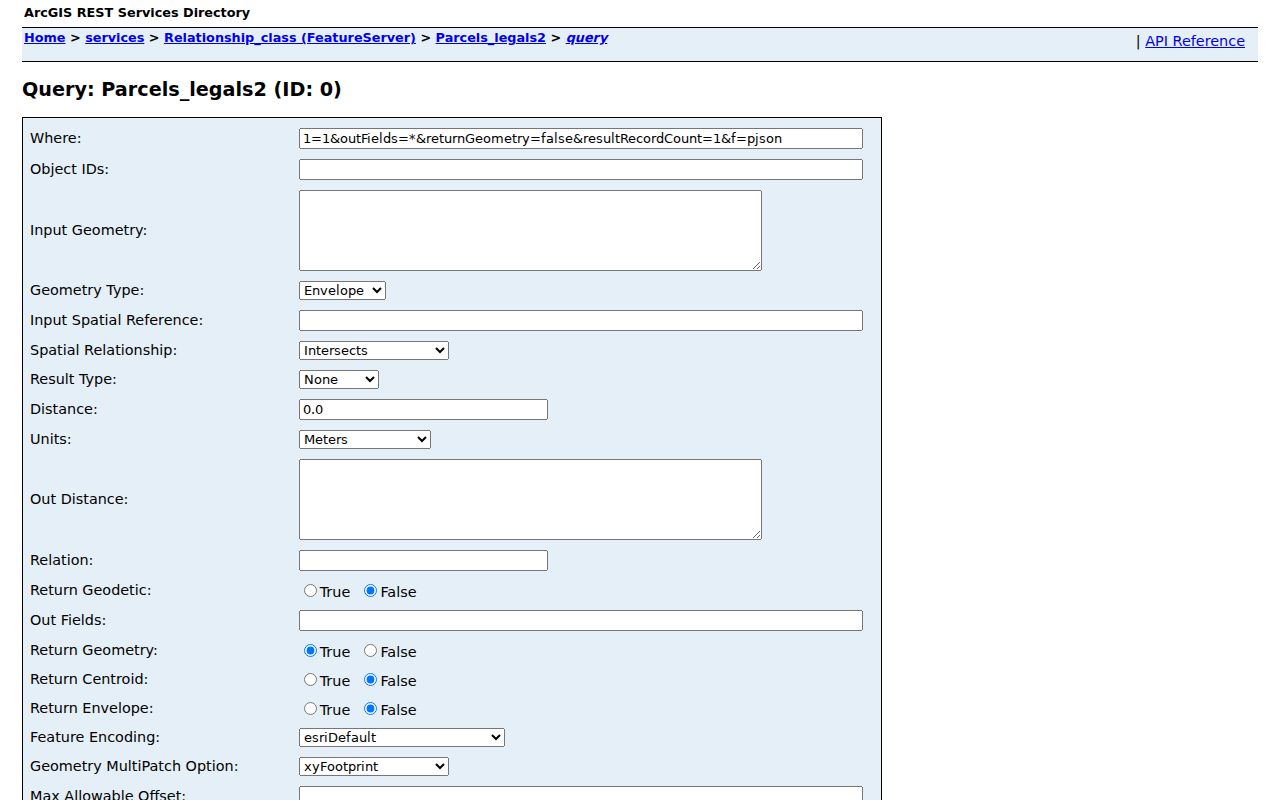
Year labels matter here. Read SEV and taxable values for the displayed roll year, since tax-bill columns may represent prior summers, winters, or village levies.
Cheboygan County Three Value Measures
Michigan's assessment system relies on related but distinct figures. Under MCL 211.34, County Equalization examines local rolls each year and studies sales and appraisals. The local assessor still sets each parcel's assessment. The state's constitutional level is 50% of true cash value, so SEV should never be read as a full market estimate.
- Assessed value
- The local assessor's value before county and state equalization.
- State Equalized Value
- The equalized assessment at the state-required level.
- Taxable value
- The capped value used with millage to calculate tax.
- Millage
- Tax rate applied per thousand dollars of taxable value.
A transfer can change the taxable-value cap the following year. Review the Michigan Treasury transfer guidance before assuming a seller's tax history predicts a buyer's next bill.
Note: A recorded sale price, true cash value, SEV, and taxable value answer different questions and should not be substituted for one another.
Find Cheboygan County Tax Balances
The Treasurer's BSA instructions describe the tax-bill route. Create or use an account and choose Municipalities. Select Cheboygan County, then search by parcel number, owner name, or address. For address searches, the county says to enter only the numeric street portion. Select the property. Read the amount due shown in red before choosing any payment action.
- Find the parcel in GIS and copy the full parcel number.
- Open BSA Online and select Cheboygan County.
- Search by parcel, owner, or numeric street portion.
- Open the matching property and review the amount due and status.
- Contact the Treasurer if the identity or balance is unclear.
The county lists a $6 non-owner search charge, a 2.95% card convenience fee, and a $2.95 flat e-check fee. Fees can change. Confirm them on the county page before submitting payment.
See the Cheboygan County Tax Portal Entry
The county-linked BSA Online municipality page is the destination for tax searches and payment steps.
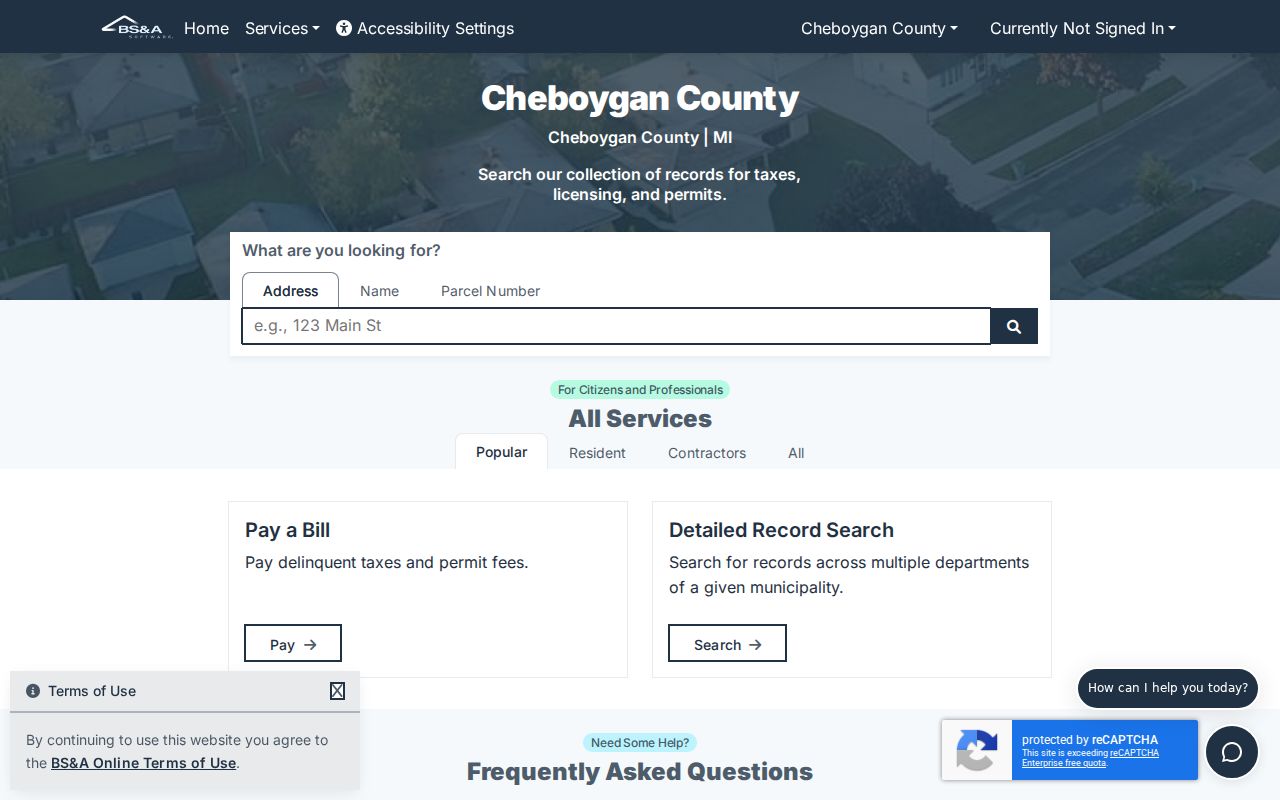
This view is a starting screen, not proof that a payment posted. Save the parcel number and verify any time-sensitive balance with the Treasurer.
Principal Residence Exemption Changes the School Levy
The Michigan Principal Residence Exemption is a real lever. It can strip the 18-mill local school operating levy from a qualifying principal residence. Eligibility turns on ownership and occupancy. The assessment record or Notice of Assessment shows the exemption status. It is not a blanket cut to every charge on the tax bill.
Transfer forms matter too. Michigan supplies transfer-of-ownership and rescission forms. Form 2766 covers transactions that may be exempt from uncapping. Submit the right form to the proper local assessing unit and keep a filed copy. County Equalization provides reports and forms but does not decide every parcel-level exemption.
Note: A mailing address outside Cheboygan County does not by itself establish whether a parcel qualifies for a principal residence exemption.
Cheboygan County's 2026 Equalization Scale
The April 14, 2026 county report recommended $3,696,451,589 in total equalized value. It also recommended a 10.68% combined increase. Those are countywide equalization figures. No parcel is promised the same percentage. The report spans jurisdictions and both real and personal property.
The Equalization landing page links the county reports, forms, and property-search route. Those put the figure in context.
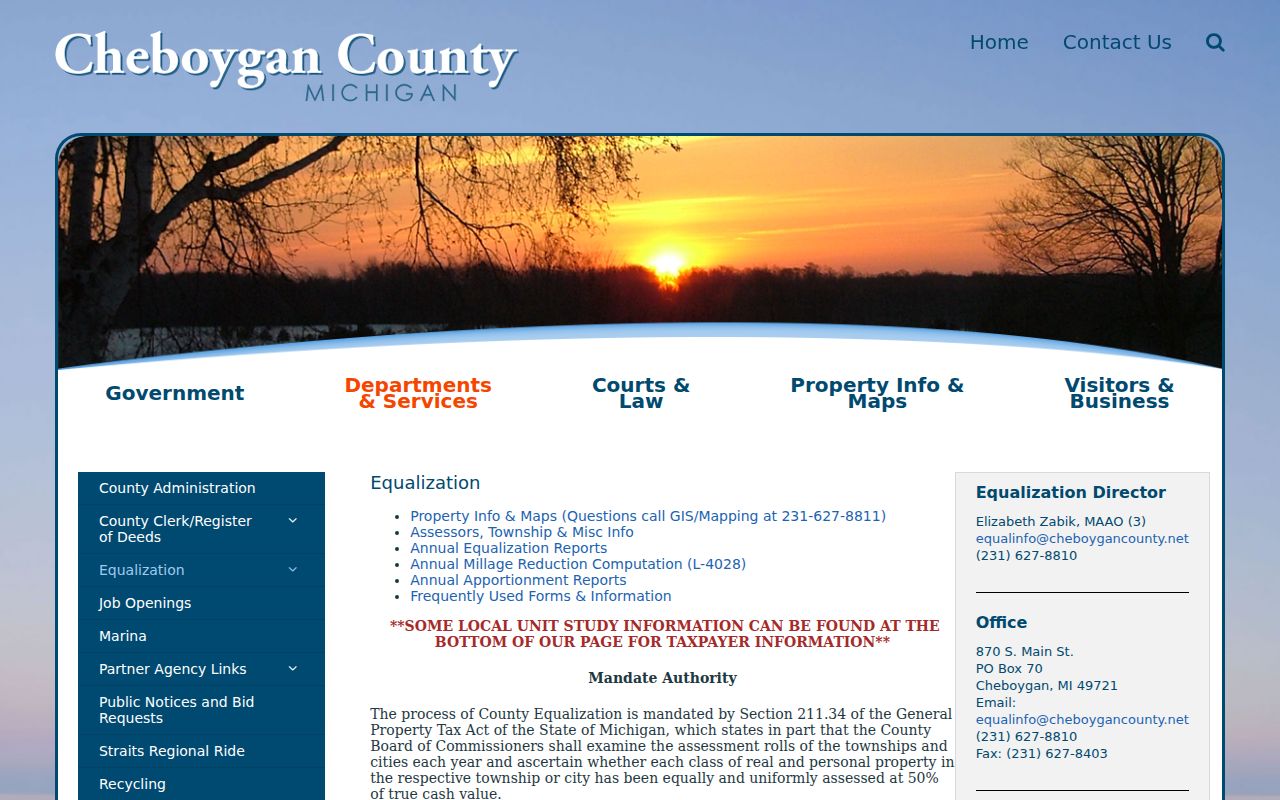
The office page reinforces the split: Equalization reviews rolls, local assessors determine individual assessments. For one parcel, place the notice beside the prior roll. Compare its classification, exemption entries, and supporting sales or appraisal evidence.
Lookup Cheboygan County Property Tax Bills
A clean lookup keeps valuation, billing, and delinquency in order. Start with the GIS identity. Move to BSA for the amount due. Use the local assessor or Treasurer whenever the web record lacks a needed detail.
- Confirm the address and APN in county GIS.
- Search BSA by the APN or the numeric street portion.
- Read the current balance, year, and payment status.
- Compare SEV, taxable value, and exemption fields with the assessment notice.
- Ask the Treasurer about delinquency and the local assessor about value or classification.
- Assessed value
- The local assessor's valuation before equalization.
- Mill rate or levy
- The rate applied to taxable value.
- Principal Residence Exemption
- A qualifying exemption from the 18-mill local school operating levy.
- Tax lien
- A governmental claim arising from unpaid property tax.
Cheboygan County Three-Year Delinquency Track
Each March 1, local units hand their delinquent real-property taxes to the county Treasurer. From there, Cheboygan County's delinquent-tax process runs on a three-year clock. That clock moves through forfeiture, redemption, foreclosure, and finally auction. A parcel showing current in BSA is not the same as a finished foreclosure. It is not an ownership transfer either. So read the stage carefully.
For any delinquent parcel, jot down the tax year. Note the amount. Note the stage it has reached. Then call the Treasurer at 231-627-8821 or write to taxinfo@cheboygancounty.net to confirm the real deadline and payoff. The public process page posts charges for each stage. But a figure straight from the office is the safer number when time is tight.
Route Cheboygan County Tax Questions
Assessment, classification, and exemption questions go to the local assessor for the parcel. County Equalization reviews the rolls and publishes reports. It does not set each individual value. For a balance, delinquency, payoff, or payment status, call Treasurer Buffy Jo Weldon's office at 231-627-8821. Deed certification and recorded ownership stay with the recorder.
When an online record skips a field you need, request the specific assessment notice, roll entry, bill, or payment record by APN and year. County offices take walk-ins and direct contacts. Michigan FOIA also gives you a written route to public records. Just describe them clearly. The statute does permit certain search, review, separation, copying, and mailing fees.
Read Year Labels Across Cheboygan County Tax Records
The parcel service carries summer, winter, and village fields for 2023 through 2025. It also holds SEV and taxable fields for 2026. One screen can therefore blend several periods. Before comparing anything, pin down the exact year and levy name. Then check the BSA balance against the assessment notice for that same period.
Village tax fields do not apply to every parcel the same way. Tax-unit codes and municipal boundaries matter, especially around Mackinaw City and Wolverine. Never infer the taxing unit from the mailing city alone.
Contest a Cheboygan County Property Tax Assessment
Your assessment notice lists the taxable valuation, classification, and exemption fields that drive local review. Michigan's March Board of Review route starts with the local assessing unit, not County Equalization. Get the current petition form and meeting schedule from that unit. Then line up the notice beside the parcel record. Organize sales, appraisal, condition, classification, or exemption evidence aimed at the disputed item.
County Equalization can explain county reports and its annual equalization role. Reach it at 870 S Main in Cheboygan or 231-627-8810/8811. Billing and payment questions belong with the Treasurer. Keeping those two contacts separate keeps an appeal on target.
Check the local calendar. The research confirms the March Board of Review route, but not one countywide filing date; obtain the current deadline from the parcel's local assessing unit.