
Trace Cheboygan County Former Owners Through Time
Treat a prior-owner search like a dated ledger. Begin with the newest deed. Record that transfer, then step back one owner at a time. Cheboygan County offers several sources for this work, though their coverage and purpose differ. The Clerk/Register of Deeds holds the recorded land instruments. The Archives of Michigan finding aid documents older county deed and tax series. The Library of Michigan points researchers to plat books, maps, and city directories. These can help identify an address or occupant.
| Source | Years It Covers | Where Held | What It Shows |
|---|---|---|---|
| LandWeb deed index | Cutoff not published | County-linked online index | Party names, instruments and deed references |
| Historic deed books | Beginning in 1854 | Register of Deeds and Archives of Michigan | Earlier conveyances and legal descriptions |
| Deed indexes and tract book | Indexes through 1903; tract book 1854-1885 | Archives of Michigan | Name and land-entry routes into volumes |
| Tax histories and plat books | Tax series 1856-1918; maps vary | Archives and Library of Michigan | Year-by-year names, lots and subdivisions |
For a recent chain, search LandWeb first. Nineteenth-century former owners call for the Archives of Michigan county guide before requesting a volume. A street-only clue may need a directory or plat first.
Start the Cheboygan County Owner Chain
The county GIS parcel layer offers a practical bridge into deed history. Its public fields show the owner name, situs and mailing addresses, legal description, and liber/page reference. Copy all of it before leaving the map. Addresses can change. The legal description and recorded reference keep pointing to the same land. Open the cited deed next. The grantee is the buyer; the grantor is the seller. That grantor becomes the former owner you chase next. Search the same name as a grantee to find the earlier acquisition. Keep a separate row for every transfer, even when parties share a surname or trust name. One county parcel sample lists liber/page 1489/976 plus earlier references in its legal text. That illustrates why a parcel card is a routing tool, not the chain itself. The county-linked LandWeb screen serves as the online entry point for a recorded-name search.
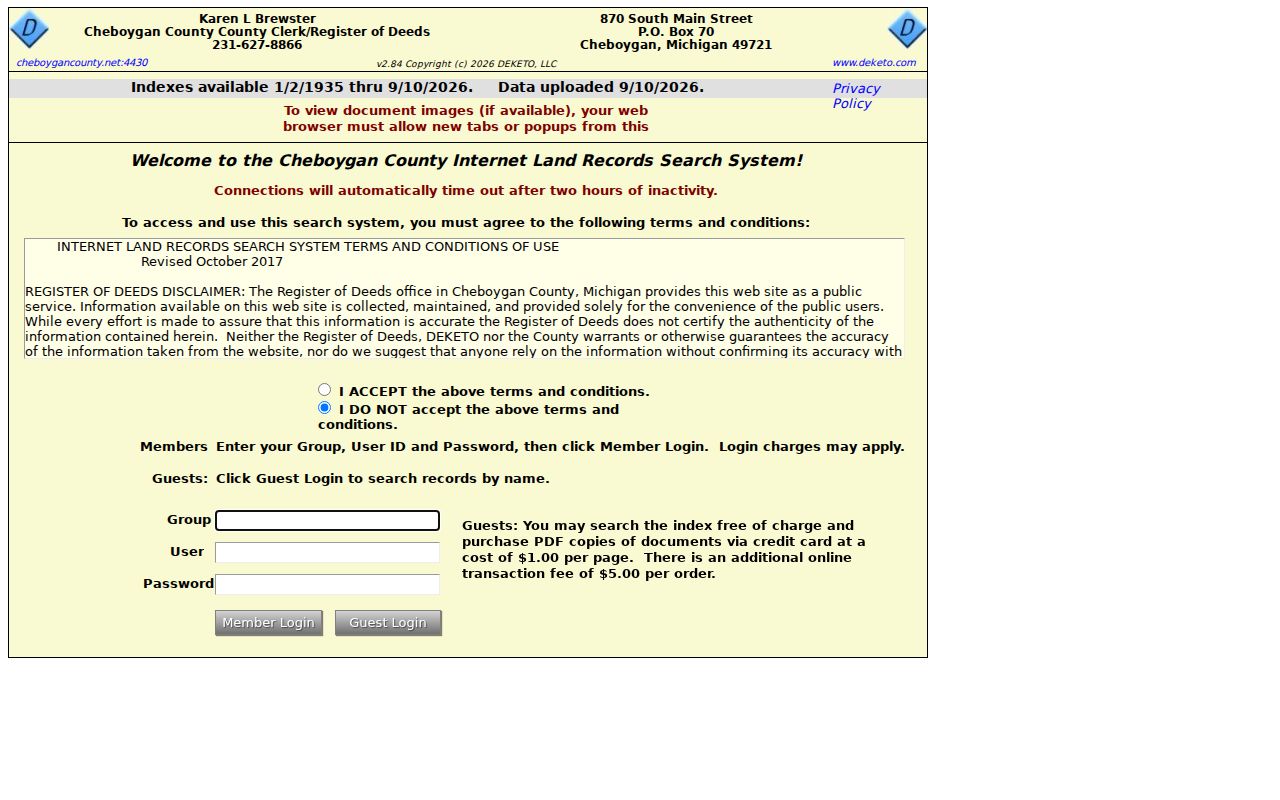
The session-based index supplies leads that still must be matched to the correct legal description and instrument.
Name Variants Hide Cheboygan County Owners
Former owners can appear under an individual name, spouses together, a trustee, an estate, or a company. Search surname-first and given-name forms when LandWeb allows, and try trust or entity names separately. One spelling change can create a false break in the chain.
| Record wording | Useful next search | Check |
|---|---|---|
| Individual grantee | Surname and given-name variants | Legal description and deed date |
| Trustee or living trust | Trust name and each trustee | Vesting language in the deed |
| LLC or corporation | Exact entity name | Michigan business registry status |
| Estate or personal representative | Decedent and estate case | Probate order and later deed |
The county layer may list a care-of string or mailing address that differs from the Cheboygan County situs. Keep it as a clue. The mailing location is not the property's jurisdiction.
Cheboygan County Deeds Reach 1854
The Archives of Michigan guide cites 1854 as the strongest documented starting date for old Cheboygan County deed records. That same guide describes deed indexes running through 1903. It also lists a tract book covering 1854 to 1885. These series matter when the web index stops, when an older name returns nothing, or when a legal description points to an early land entry. The county's official pages do not publish LandWeb's earliest online year. A blank web result never proves a deed is missing. Ask the Cheboygan County Clerk/Register of Deeds which book, film, index, or in-office method covers the year you need.
Coverage limit. LandWeb's cutoff is not officially stated; earlier former owners may require deed books, indexes, microfilm or an archives request.
Walk a Cheboygan County Deed Chain Backward
Work from evidence already tied to the parcel. A chain built only on similar names can jump to unrelated land, especially where one owner held several tracts.
- Find the present parcel in county GIS and copy its full legal description and liber/page.
- Open the current acquisition deed and enter its grantor, grantee, date, deed type and land description in a timeline.
- Search the grantor as an earlier grantee, then compare the land text before accepting the match.
- Repeat the process until the online index ends, then continue with the reverse index, deed books or Archives of Michigan.
- Grantor / grantee
- The conveying party and receiving party named in a deed.
- Chain of title
- The ordered sequence of recorded transfers affecting the same land.
- Reverse index
- An index organized from the grantor side, useful when tracing back from a buyer.
- Legal description
- The lot, plat or section-based land identity that can survive an address change.
Warranty and quitclaim deeds can both appear in a chain. The deed type alone proves nothing about full conveyance, so match the parcel and read the instrument.
Probate Bridges Cheboygan County Prior Owners
A death can interrupt the simple seller-to-buyer pattern. The Probate Court file may identify an estate, fiduciary, order, or devise, and a later personal-representative deed returns the trail to the Register of Deeds. The recorded deed remains the land-record link. The court file explains the authority behind it. Search the decedent's name through the MiCOURT Case Search. Request the public file from the Cheboygan Probate/Family Court when needed. Protected personal information may be omitted. Compare the estate name and representative against the deed rather than assuming an heir automatically became the recorded owner. Question: Is every former resident a former owner? No. Directories, obituaries, and tax rolls show occupancy or responsibility, but only a deed or other controlling transfer record places a person in the ownership chain.
Plats Reconnect Cheboygan County Ownership
Some old Cheboygan County deeds describe land with nothing but lot-and-block language. A recorded plat translates that into a real map. The Library of Michigan county guide lists historic maps and plat books from 1902, 1933 and 1960. County GIS legal strings still preserve subdivision names such as Needle Point, Green Maples, Black River Valley and Mackinaw-area additions. Plat names often outlast street addresses.
Historic tax records at the Archives of Michigan span parts of 1856 through 1918. The coverage is uneven. A repeated name can bridge quiet years. A tax entry is not a conveyance, though. Use it to frame a date range, then take the question back to the deed index.
City directories cover Cheboygan from 1910 to 1990. The runs have gaps. Their strength is address and occupant clues. Pair a directory entry with a plat, a tax record and a deed before you call the listed person one of the former owners.
Note: A plat name or liber/page usually survives address changes better than a modern street search, so preserve both before opening older indexes.
Keep a Cheboygan County Former-Owner Evidence Log
A clear log makes uncertain links visible. Write down what each Cheboygan County source actually establishes, not what it seems to imply, and you will avoid repeating the same parcel or deed index search twice.
| Transfer date | Grantor to grantee | Deed type | Book/page or instrument |
|---|---|---|---|
| Newest verified date | Current deed parties | As recorded | GIS or deed reference |
| Prior verified date | Earlier deed parties | As recorded | Earlier liber/page |
| Unresolved interval | Possible tax or probate name | Not yet proved | Volume request pending |
Keep the small details too. Retain search spellings, rejected matches, plat names and the date a Cheboygan County office responded, since that context matters when the chain moves from LandWeb to paper or microfilm.
Know Where Cheboygan County Ownership Records End
Deed records in the Archives guide reach back to 1854, the year Cheboygan County was organized. That is a deep chain. An older private chain may end at a federal land patent or tract entry instead of another county deed. No courthouse fire erased a record era here. Gaps usually come down to indexing, spelling, description or access until the custodian says otherwise.
For an unresolved interval, give the Register of Deeds or the archives real material to work with. Include the former owner's name variants and approximate years. Add the township or subdivision, the full legal description, and the last verified liber/page. Ask for the reverse index. Also request the volume covering that interval. That focused request works far better than asking an office to research an entire house history.
Lawful use. Former-owner research supports house history, estate work and property diligence. Never use public records to stalk, harass or harm a living person.