
Cheboygan County Deed Types
The Clerk/Register of Deeds records warranty deeds, quitclaim deeds, mortgages, and other land instruments for Cheboygan County. Each deed documents a conveyance, its parties, recording data, and the land description. Consideration or transfer-tax markings may appear too. Read the instrument type carefully before assuming a full ownership transfer.
| Deed Type | What It Does | Common Use |
|---|---|---|
| Warranty deed | Conveys the grantor's interest with stated covenants | Ordinary sale or transfer |
| Quitclaim deed | Conveys whatever interest the grantor holds | Family, estate, or title cleanup |
| Personal representative or trustee deed | Transfers through an estate or trust role | Probate or trust administration |
| Sheriff or tax-related deed | Reflects a statutory sale process | Foreclosure or delinquent-tax transfer |
| Mortgage or release | Creates, assigns, or discharges an encumbrance | Loan and payoff record |
Mortgages, judgment liens, restrictions, rights-of-way, and easements often sit near deeds in the index. None of them means a sale happened. Keep hunting for later releases, satisfactions, assignments, and amendments. Confirm every legal description points to the same parcel.
LandWeb Opens Cheboygan Deed Search
Cheboygan County links straight to the LandWeb public index, a dynamic, session-based system. The county's static pages do not publish its earliest online year. They also leave out its full search fields, image coverage, and image price. So check any search result against the official record. Do not assume every deed is online. The county-linked recorder index entry screen is the starting point.
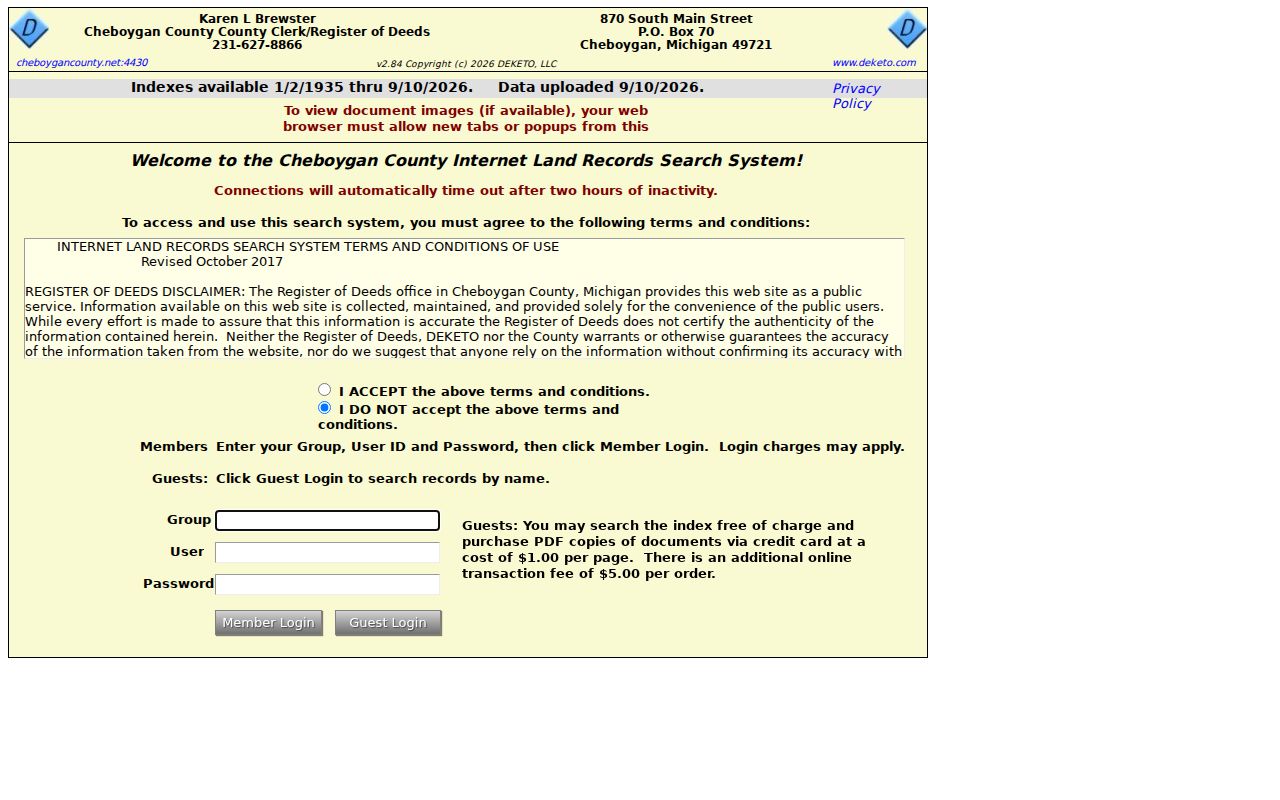
Stay in the session while you note parties, recording date, instrument type, liber and page, and the legal description. Those details travel well. If an image is missing, take them to the recorder counter or a request channel.
Read Cheboygan Liber and Page
Liber means the recorded book. Page pinpoints the spot inside it. Cheboygan GIS exposes a liberpage field, and older legal text may cite earlier book references. Copy both numbers before leaving the map. Treat a GIS reference as a bridge into deed records, not a certified image.
A county Planning Commission packet includes a sample warranty deed. It was recorded at Liber 1533, Page 543. Its field inventory lists grantor, grantee, and consideration. It also includes a received-for-record notation, a $30 warranty-deed receipt, a $5 tax certification, transfer-tax stamps, legal-description clauses, and earlier liber references. Those fees describe that one sample. Note: Match the legal description, not just the street address, when following a liber/page reference.
Follow Cheboygan Grantor-Grantee Links
A grantor conveys an interest. A grantee receives it. Start with the most recent likely acquiring deed. Then walk backward one transfer at a time. Names alone will not carry you through Cheboygan deed records. Lean on recording references and legal text to stay on the same parcel.
- Use the GIS owner and liber/page as leads to find the newest purchase deed.
- Read the grantor, grantee, recording date, legal description, and prior references.
- Search that grantor as an earlier grantee and match the same land description.
- Repeat until the online trail stops, then shift to the recorder's books or Archives finding aids.
- Grantor
- The party transferring an interest.
- Grantee
- The party receiving an interest.
- Chain of title
- The ordered sequence of recorded transfers tied to the same land.
- Liber/page
- Cheboygan's book-and-page reference for a recorded document.
Trusts, estates, and companies complicate how names appear in the index. The index often allows a broader search. Search both the legal entity and the person acting in a representative role. Michigan's current MiBusiness Registry can help identify an LLC name. The deed itself still controls the parcel connection.
Historic Cheboygan Deeds Start in 1854
The Archives of Michigan guide documents Cheboygan County deeds from 1854 through 1895 and deed indexes from 1854 through 1903. Mortgage books run 1855 through 1905. Mortgage indexes run 1854 through 1900, and tract books run 1854 through 1885. LandWeb's cutoff year remains unpublished. An archive request works best with the last known owner, an approximate year, the legal description, and a recording reference. Tax histories from 1856 through 1918 and assessment rolls from 1860 through 1889 can bridge a stubborn gap. A tax listing never proves title. The 1902 plat book and the 1960 owner-indexed farm plat book add useful geographic clues.
Cheboygan Liens Need Later Releases
Search mortgages, assignments, discharges, construction liens, judgment liens, tax instruments, easements, restrictions, rights-of-way, and plats right alongside Cheboygan deed records. A recorded obligation often gets released later under the lender, assignee, or lienholder instead of the owner. Search both sides of the ledger. Follow the newer instrument reference to the end.
| Record | First check | Later proof |
|---|---|---|
| Mortgage | Borrower, lender, legal description | Discharge or satisfaction |
| Assignment | Original lender and assignee | Later assignment or release |
| Easement or restriction | Deed, plat, or separate instrument | Amendment, release, or court order |
| Lis pendens or judgment | Recorder entry and court file | Disposition, withdrawal, or satisfaction |
Check tax balances separately with the Treasurer, since a BSA balance and a recorded release answer different questions.
Cheboygan Property Activity Alert
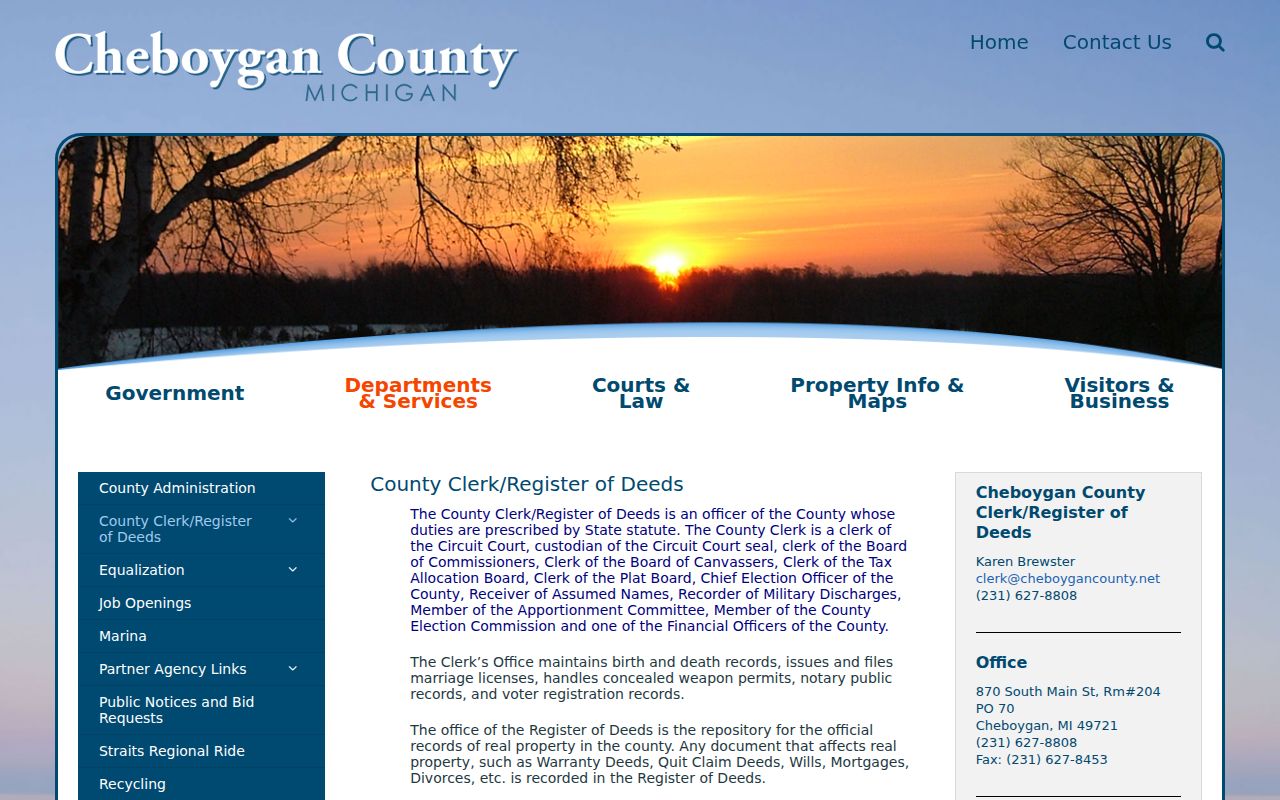
The Register of Deeds page offers a Property Activity Alert by recorded name. Enrollment is handled by phone at 231-627-8866; the county page provides no online form. An email can flag a later recording under the enrolled name. The alert cannot block or undo a filing, though.
Name variants, trustees, and LLC names may slip past a personal-name enrollment. Treat the alert as one early-warning step. Report any suspicious filing straight to the recorder.
Request Cheboygan Deed Copies
Start with any image available in LandWeb. For an office copy, contact the Cheboygan County Clerk/Register of Deeds at 870 S Main, PO Box 70, Cheboygan, MI 49721. The main clerk number is 231-627-8808, and the Register of Deeds number is 231-627-8866. Register hours run 8:30 a.m. to 4:30 p.m. The county lists in-person, telephone, and office payment options. Its static page does not publish a verified per-page or certified-copy rate.
Give the office the parties, instrument type, recording date, liber/page, and legal description. Ask whether the copy should be plain or certified. Confirm the current charge before sending payment. Michigan FOIA remains a written route for other identifiable public records. A routine deed-copy request should first follow the recorder's stated process.
Mail and counter requests work best when they identify one instrument rather than a broad ownership question. If an index result is unclear, ask staff which details distinguish same-name parties. Ask also whether an older book is still held locally or described by the Archives.
Retain the office receipt and copy certification with your research notes.
Recorded, not guaranteed. Cheboygan County deed records show filed instruments, not a legal title opinion. Unrecorded interests, indexing issues, and later releases require professional title review.